• Skip to primary navigation
  • Skip to main content
  • Skip to primary sidebar
Brunini Law
Menu
  • About Us
      • Firm Overview
      • Diversity Matters
      • In the Community
      • Pro Bono
      • Legal Networks
      • Brunini, Grantham, Grower & Hewes, PLLC, founded over one century ago, today is one of Mississippi’s largest and most respected law firms. Our Firm’s practice is organized into three major areas of concentration: Commercial, Litigation and Regulatory law. Whether in a courtroom or the boardroom, we treat our client's business as we would our own.
    Close
  • About Us
  • People
      • Attorney Directory
      • Attorney Search
      • As one of Mississippi's oldest law firms, many of our attorneys have unmatched experience in industry sectors ranging from Energy to Telecommunications - from Litigation to Cyber Security.
    Close
  • People
  • Practices
      • Commercial
      • Litigation
      • Regulatory
      • The practice of law at Brunini is diverse, comprehensive and sophisticated. The scope of our services is coordinated across clients, industries and issues. The Brunini Firm is organized into three major areas of concentration that function optimally within the context of the law itself: Commercial, Litigation and Regulatory.
    Close
  • Practices
  • Careers
      • Recruiting
      • Summer Associates
      • Diversity
      • The Brunini Firm recruits new quality attorneys to meet its clients' increasing demands. The Firm interviews at a number of law schools and has an active summer clerkship program which is an integral part of its overall recruiting effort. We also recruit experienced attorneys with proven abilities and particular expertise to help us meet our clients' specific needs.
    Close
  • Careers
  • News
      • News
      • Blog
      • Recent Experience
      • Rankings & Awards
      • Newsletters
      • Newsletter Signup
      • Check here often for firm news, blogs, rankings and awards, and other recent developments involving Brunini and its lawyers. You can also review recent firm newsletters here and sign up to receive the newsletters by email.
    Close
  • News
  • Office
      • Jackson
      • P: 601-948-3101
        190 East Capitol Street
        The Pinnacle Building, Suite 100
        Jackson, MS 39201
    Close
  • Office
    • Jackson
    • Close

Brunini Law

Mississippi Commission on Environmental Quality Summary of Meeting Held February 26, 2015

March 2, 2015 by Brunini Law

Prepared By Brunini, Grantham, Grower & Hewes, PLLC

The Environmental Practice Group of the Brunini Law Firm publishes a summary of the proceedings of each monthly meeting of the Mississippi Environmental Quality Permit Board and of the Mississippi Commission on Environmental Quality. We strive to provide, in a succinct newsletter format, the key points addressed in each meeting that will be of interest to the regulated community in Mississippi.

If you have any questions concerning the content of a newsletter it would like further information about the matters addressed in a newsletter, please contact John Milner, the Brunini Firm Environmental Practice Group leader, at jmilner@brunini.com or (601) 960-6842.

Meeting Summary

The Mississippi Commission on Environmental Quality convened at 9:00 a.m. on February 26, 2015, at the offices of the Mississippi Department of Environmental Quality in Jackson. The Commission approved minutes from the previous meeting held on November 20, 2014.

Following a prepared agenda, items considered were as follows:

FY 2016 TITLE V FEE RECOMMENDATION

A Public Hearing concerning the FY2016 Title V Air Permit Fee was held on January 15, 2015. No comments were received.  Copies of the public hearing transcript have been provided.  The staff will recommend that the Commission set the FY2016 Title V fee at $41.00 per ton of regulated air pollutants with a minimum fee of $250.00.

PILOT TRAVEL CENTERS LLC—MOSS POINT, JACKSON COUNTY—PRESENTATION OF EVIDENTIARY HEARNING RECORD AND RECOMMENDATION OF HEARNING OFFICER

Pilot Travel Centers LLC requested a formal evidentiary hearing after MDEQ staff determined that Pilot was not eligible for reimbursement for assessment and remediation costs from the Mississippi Groundwater Protection Trust Fund for releases that occurred in March 2013 and thereafter, at Pilot’s Underground Storage Tank site located at 6705 Highway 63 in Moss Point.  On May 22, 2104, the Commission designated Ricky Luke, Assistant Attorney General, as the hearing officer to conduct the hearing to prepare a record for the Commission’s consideration.  Hearing officer Luke conducted the evidentiary hearing on Sept. 11, 2014. Mr. Luke presented his findings of fact and his recommended decision for the Commission’s consideration.

CERTIFICATIONS APPROVED

Asbestos:                     319 certifications

Lead Paint:                  78 certifications

Underground Storage Tanks:            5 certifications

EMERGENCY CLEAN-UP EXPENSES APPROVED

Six (6) emergency clean-up expenditures occurred since the last report.

ADMINISTRATIVE ORDERS APPROVED

Twenty-five (25) administrative orders were issued by the Executive Director and approved by the Commission since the last report.  These include the following matters:

Program Area Number of Orders Penalty Range
NPDES 3 $6,250 – $50,000
Large Construction Stormwater 3 $5,000 – $23,000
Asbestos Removal 5 $2,500 – $7,500
Air 3 $19,000 – $37,500
Hazardous Waste 3 $15,000 – $275,000
Surface Water Withdrawal 1 $60,000
Solid Waste 1 $4,000

An order confirms the adoption of the Commission Regulation 11 Mississippi Administrative Code, Part 2, Chapter 11 entitled “Regulations for Ambient Air Quality Nonattainment Areas” along with the associated Revision to the Mississippi State Implementation Plan for Control of Air Pollution (SIP Revision).

An order confirms the adoption of amendment to Commission Regulation 11 Mississippi Administrative Code, Part 1, Chapter 1 entitled “Air Emission Regulations for the Prevention, Abatement, and Control of Contaminants.”

The next Commission meeting is scheduled for March 26, 2015.

This Newsletter is a publication of the Environmental Department of the law firm of Brunini, Grantham, Grower & Hewes located in Jackson, Mississippi.

This Newsletter is not designed or intended to provide legal or professional advice, as any such advice requires the consideration of the facts of the specific situation.

IRS Circular 230 Notice

To ensure compliance with requirements imposed by the IRS, we inform you that, unless specifically indicated otherwise, any tax advice contained in this communication (including any attachments) was not intended or written to be used, and cannot be used, for the purpose of (i) avoiding tax-related penalties under the Internal Revenue Code, or (ii) promoting, marketing, or recommending to another party any tax-related matter addressed herein.
Related Attorneys

  • John E. Milner
  • Gene Wasson

Small Community Banks in Rural Areas Still Make Money?

February 27, 2015 by Brunini Law

“Wait a minute,” you say, “this can’t be right. Everything I have heard in banking for the past 20 years has told me my bank must get larger. We must abandon these old, rural markets for the greener pastures of America’s cities and suburbs, where loans and deposits flow like milk and honey.” Well, sit down, because the revelations discussed in my last post become even more dramatic. As mentioned in my earlier post, the UBPR divides the 12 Peer Groups covering banks under $300 million not only based upon size, but also based upon their “metropolitan” or “non-metropolitan” locations and their number of branches. By examining these 12 peer groups, I discovered that ”metropolitan bank” peer groups had average ROAs over the last 5 years (i.e., 0.44%) that collectively averaged approximately half those of “rural” peer groups (i.e., 0.87%), while having collective average ROEs (i.e., 3.50%) that were less than half of those recorded by their more rural cousins (i.e., 8.02%). Not only are rural banks more profitable than their metropolitan competitors, they have been running circles around them for the last five years. How do those same rural peer group averages compare to the averages for the “larger” peer groups 1, 2, and 3? Very favorably, thank you. The collective average ROE (i.e., 8.02%) for these rural peer groups (i.e., 5, 7, 9, 11, 13, and 15) was higher than the average ROE for each of the three larger peer groups (7.79%, 7.60%, and 7.59%, respectively), and the collective average ROA (i.e., 0.87%) for these rural peer groups was higher than all but one of the average ROAs of the three larger peer groups (0.88%, 0.79% and 0.80%, respectively). Therefore, maybe it’s not size that is the ultimate differentiator, but instead location. Contrary to everything I have believed and heard to this point, maybe it is a bank’s rural location that is its ace in the hole!

Chart 3: Average “Metropolitan” ROA vs. “Non-Metropolitan” ROA, 2010 – 2014

Chart-3


Chart 4: Average “Metropolitan” ROE vs. “Non-Metropolitan” ROE, 2010 – 2014

Chart-4


What is the one rumor that appears to be true? Well, that may be that brick and mortar are the albatross that everyone believes them now to be. Banks in the last 12 peer groups that have “more” branches (i.e., 4, 5, 8, 9, 12, and 13) had a collectively lower average ROA (i.e., 0.56% to 0.75%) than the peer groups with “fewer” branches, and their collective average ROE was lower as well (i.e., 5.20% compared to 6.33% for peer groups with ”fewer” branches).

Chart 5: Average “More Branches” ROA vs. “Fewer Branches” ROA, 2010 – 2014

Chart-5


Chart 6: Average “More Branches” ROE vs. “Fewer Branches” ROE, 2010 – 2014

Chart-6


Maybe I’m the only one surprised by these revelations. After all, the “User’s Guide for the Uniform Bank Performance Report – Technical Information” notices the following:

Consistent differences in peer group performance are apparent over time. For example, the average non-branch bank in a non-metropolitan area tends to have lower overhead, lower noninterest income, higher profitability and higher capital ratios than similar sized branch banks located in metropolitan areas.

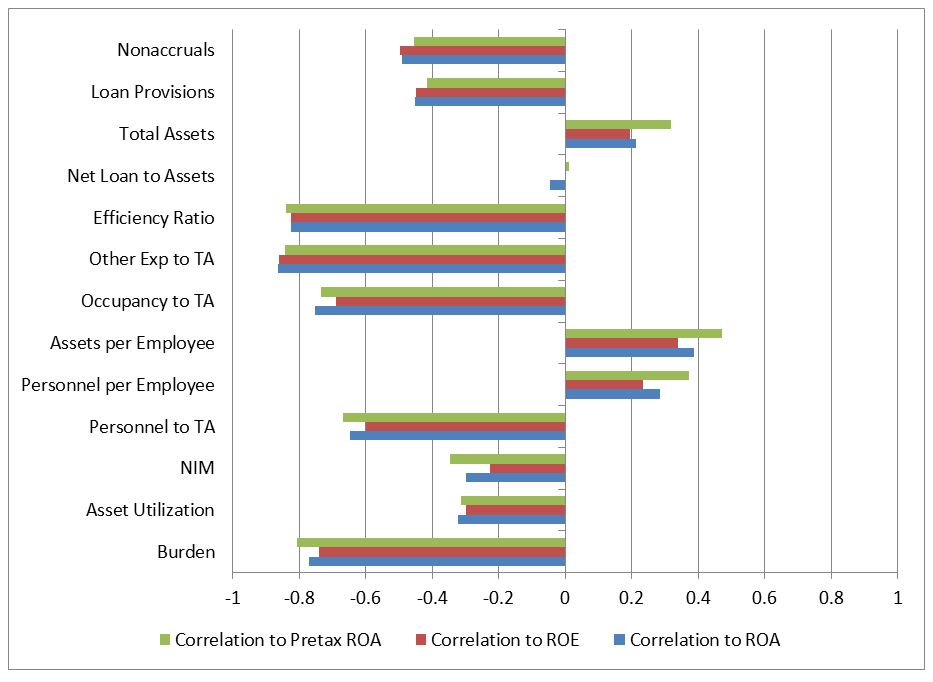
Something tells me that not many people pick this up for bed time reading, though, so its truths may not be widely known. “Still,” you say, “how could it be that smaller, more rural banks turn a higher profit than larger, more metropolitan ones? That can’t be true since my bank is dedicating most of its resources to the nearby metropolitan area where all of its loan growth has occurred over the last five years.” I will elaborate further on what the UBPR data reveals as reasons for this irony in my next post, but to give you a hint, it is clearly related to the first metric listed in the “User’s Guide” quote above ( i.e., lower overhead). You may be generating a lot more loans and deposits from that metropolitan area and growing quickly as a result, but it also costs you a lot more money to do so. Maybe your father knew what he was telling you when he preached that a penny saved is always a penny earned.

Mississippi Environmental Quality Permit Board Summary of Meeting Held February 10, 2015

February 24, 2015 by Brunini Law

Prepared By Brunini, Grantham, Grower & Hewes, PLLC

The Environmental Practice Group of the Brunini Law Firm publishes a summary of the proceedings of each monthly meeting of the Mississippi Environmental Quality Permit Board and of the Mississippi Commission on Environmental Quality. We strive to provide, in a succinct newsletter format, the key points addressed in each meeting that will be of interest to the regulated community in Mississippi.

If you have any questions concerning the content of a newsletter it would like further information about the matters addressed in a newsletter, please contact John Milner, the Brunini Firm Environmental Practice Group leader, at jmilner@brunini.com or (601) 960-6842.

Meeting Summary

The Mississippi Environmental Quality Permit Board (Board) convened its regular monthly meeting at 9:00 a.m. on February 10, 2015 at the offices of the Mississippi Department of Environmental Quality in Jackson.  Mrs. Leslie Royals, PE chaired the meeting.  The Board approved minutes from the January meeting and all non-controversial actions/certifications by the staff since the January meeting.  Following a prepared agenda, items considered were as follows:

OFFICE OF GEOLOGY

In accordance with staff’s recommendations, the Board approved the following surface mining bond releases and permits to approve.

 Surface Mining Bond Releases:

Permittee

County

Permit

Eutaw Construction Company, Inc.

Pontotoc

P11-021

Eutaw Construction Company, Inc.

Pontotoc

P11-022

Riverside Construction Company, Inc.

Warren

P10-030

Walters Development, LLC

Jones

P07-030

Mr. James Matheny of MDEQ staff recommended approval of the following surface mining permit.

Surface Mining Permit Approvals:

Permittee

County

Permit

Staff Recommendation

Rockco Mining LLC

Panola

P13-09A

Approve

OTHER BUSINESS:

The next Permit Board meeting will be held on March 17, 2015 at 9 a.m.

This Newsletter is a publication of the Environmental Department of the law firm of Brunini, Grantham, Grower & Hewes located in Jackson, Mississippi. This Newsletter is not designed or intended to provide legal or professional advice, as any such advice requires the consideration of the facts of the specific situation.

IRS Circular 230 Notice

To ensure compliance with requirements imposed by the IRS, we inform you that, unless specifically indicated otherwise, any tax advice contained in this communication (including any attachments) was not intended or written to be used, and cannot be used, for the purpose of (i) avoiding tax-related penalties under the Internal Revenue Code, or (ii) promoting, marketing, or recommending to another party any tax-related matter addressed herein.

Related Attorneys

  • John E. Milner
  • Gene Wasson

Community Banks to America: “The Reports of My Death Were Greatly Exaggerated.”

February 19, 2015 by Brunini Law

We all know the story and ultimate conclusion, right? Commercial banking is becoming more complex, regulations are multiplying exponentially each passing day, commercial activity and related loans are migrating more and more to metropolitan areas, so therefore small town, community banks are quickly becoming a thing of the past. They simply can’t keep up. Not only are they losing loans to banks in faster growing, more populated areas, but they also are struggling to hire sufficient staff to comply with regulation, much less chase loans. They just don’t have the economies of scale or markets to support the inevitable overhead explosion and attract the top talent to their slow growing, rural economies. Sadly, their days are numbered. Within a decade or two, rural community banks with assets less than $1 billion will go the way of the dinosaur, victims of that terrible meteor named Dodd-Frank.

This must be the truth, right? Everything we learned in macroeconomics demands it. Bigger banks have more economies of scale to support the rising fixed costs associated with commercial banking, and smaller banks will eventually tap out. Metropolitan banks have more access to capital, loans, and growing deposit bases and therefore have an inherent advantage over their rural cousin the country bank. As a former CFO and COO of a rural, community bank, I know I bought it hook, line, and sinker. Looking at growing overhead, shrinking loans, and aging management, I was convinced this storyline was the only possible one. Heck, it’s a big reason why I decided a future in community banking was not for me, opting instead to return to the much more stable world of practicing law (note the presence of my tongue which is firmly implanted in my cheek).

The problem is, five years after the end of the great recession, the bank statistics published in the Uniform Bank Performance Reports (“UBPR”) by the Federal Financial Institutions Examination Council (“FFIEC”) simply don’t support this idea that small town community banks are dead, or that they are even dying. As a matter of fact, there is some argument to the contrary, at least in certain contexts.

In reaching this conclusion, I examined the UPBR average peer group data from the last five years for each of the 15 major peer groups for insured commercial banks. I excluded the peer groups related to De Novo banks created in the last five years which had the potential to skew the analysis due to the unique challenges faced by De Novo institutions. These 15 different peer groups, which included 5,619 banks, are delineated as follows:

Peer Group 1: Insured commercial banks in excess of $3 billion
Peer Group 2: Insured commercial banks between $1 billion and $3 billion
Peer Group 3: Insured commercial banks between $300 million and $1 billion
Peer Group 4: Insured commercial banks having assets between $100 million and $300 million, with 3  or more full service banking offices and located in a metropolitan statistical area
Peer Group 5: Insured commercial banks having assets between $100 million and $300 million, with 3 or more full service banking offices and not located in a metropolitan statistical area
Peer Group 6: Insured commercial banks having assets between $100 million and $300 million, with 2 or fewer full service banking offices and located in a metropolitan statistical area
Peer Group 7: Insured commercial banks having assets between $100 million and $300 million, with 2 or fewer full service banking offices and not located in a metropolitan statistical area
Peer Group 8: Insured commercial banks having assets between $50 million and $100 million, with 3 or more full service banking offices and located in a metropolitan statistical area
Peer Group 9: Insured commercial banks having assets between $50 million and $100 million, with 3 or more full service banking offices and not located in a metropolitan statistical area
Peer Group 10: Insured commercial banks having assets between $50 million and $100 million, with 2 or fewer full service banking offices and located in a metropolitan statistical area
Peer Group 11: Insured commercial banks having assets between $50 million and $100 million, with 2 or fewer full service banking offices and not located in a metropolitan statistical area
Peer Group 12: Insured commercial banks having assets less than $50 million, with 2 or more full service banking offices and located in a metropolitan statistical area
Peer Group 13: Insured commercial banks having assets less than $50 million, with 2 or more full service banking offices and not located in a metropolitan statistical area
Peer Group 14: Insured commercial banks having assets less than $50 million, with 1 full service banking office and located in a metropolitan statistical area
Peer Group 15: Insured commercial banks having assets less than $50 million, with 1 full service banking office and not located in a metropolitan statistical area

As of December 31, 2014, the average number of banks per peer group was 374.6 banks. The largest peer group by far was Peer Group 3 (i.e., banks between $300 million and $1 billion), which included 1,254 banks. The smallest peer group was Peer Group 12 (i.e., banks less than $50 million located in a metropolitan area and having 2 or more full branches), which contained 63 banks. The median peer group was Peer Group 2 (i.e., banks between $1 billion and $3 billion) with 321 banks.

This UBPR data separates banks into peer groups that distinguish them not only on the basis of size, but also based upon the number of full service branches operated by a bank as well as whether the bank is located in a metropolitan or non-metropolitan area. For the purposes of clarification, it is important to note that a bank may be classified as a non-metropolitan bank and still have full service branches in a metropolitan area, and vice versa. For example, a $150 million commercial bank whose main office is in a non-metropolitan area but who also operates another full service branch in a metropolitan area is part of Peer Group 7, which includes banks between $100 million and $300 million of assets that have 2 or fewer branches and are not located in a metropolitan area. Therefore, it is the main office location of the bank that controls and not the location of its branches. For the purposes of the UBPR, a metropolitan area is one classified as a Metropolitan Statistical Area by the Office of Management and Budget.

I first stumbled upon the truths presented by the UBPR while I was analyzing the performance data of a client. With the same prejudices in mind that I stated in the opening two paragraphs, I decided to compare that bank’s data to statistics for banks in “larger” peer groups. What I discovered astonished me and interested me to the point that I decided to dig deeper. Not only did the bank’s statistics compare more favorable to the data of “larger” peer groups than it did to statistics of its own peer group, but the average numbers for the bank’s peer group 7, which is assigned to relatively smaller, rural banks, seemed to soar well above some of its larger, more metropolitan cousins.

Peer group 7, which, as mentioned above, is reserved for banks between $100 million and $300 million in assets that are located in a non-metropolitan area and have 2 or fewer branches, averaged the highest Return on Equity (“ROE”) (i.e., 10.47%) and Return on Assets (“ROA”) (i.e., 1.16%) of any peer group over the last five years. What about the next highest ROE and ROA? Well those belonged to “rural, community” banks as well. Peer Group 11 (i.e., $50 million to $100 million, 2 or fewer branches, and non-metropolitan area) boasted the next highest ROA of 0.99%, and Peer Group 5 (i.e., $100 million to $300 million, 3 or more branches, and non-metropolitan area) claimed second place in ROE with 9.12%. Third place in each category also belonged to Peer Groups 11 and 5, just in reverse with respect to the category. Peer Group 1, the peer group for the nation’s largest banks (i.e., more than $3 billion in assets), doesn’t show up on either list until you look down to fourth place, where it finished with an average ROE of 7.79% and an average ROA of 0.88% over the last five years. In my next post, we will start to examine what could be the explanation of this and what secrets it could reveal to you regarding operating a community bank in this challenging environment.

Chart-1

Chart-2


HALFORD SPEAKS AT JUDGES’ CONFERENCE

February 3, 2015 by Brunini Law

Jim Halford was a featured speaker at the Mississippi Trial & Appellate Judges Fall Conference held in Jackson, MS. on October 22-24, 2014.  Halford spoke to the judges on the subject of “Ingress and Egress in Eminent Domain Proceedings: Miss. Const. Section 110”.

Related Attorneys

  • James L. Halford

Brunini’s 2014 Super Lawyers

February 1, 2015 by Brunini Law

Attorneys from Brunini were recently selected as Mid-South Super Lawyers 2014 and eight attorneys were named Mid-South Rising Stars 2014.

Super Lawyers is a listing of outstanding lawyers from more than 70 practice areas who have attained a high degree of peer recognition and professional achievement.

Mid-South Super Lawyers

 Matt Allen-Business Litigation

Lawrence E. Allison, Jr.-Business Litigation

Leonard A. Blackwell, II-Environmental

Stephen J. Carmody- Employment & Labor

Lynne K. Green-Estate Planning and Probate

William Trey Jones, III- Business Litigation

R. David Kaufman– Business Litigation

Samuel C. Kelly- Construction Litigation

M. Patrick McDowell- Business Litigation

John E. Milner– Environmental

Christopher A. Shapley- Business Litigation

Watts C. Ueltschey- Energy & Resources

Leonard D. Van Slyke, Jr.- Tax

John E. Wade- Personal Injury Medical Malpractice: Defense

Eugene R. Wasson- Energy & Resources

Walter S. Weems –Business/Corporate

Ron A. Yarbrough- Construction Litigation

*Attorneys listed in Super Lawyers’ Top 50 in Mississippi.

Mid-South Super Lawyers – Rising Stars

Norman E. Bailey, Jr.- Business Litigation

Christopher R. Fontan- Employment & Labor

Joseph A. Sclafani- Appellate

Lane W. Staines- Health Care

Related Attorneys

  • Matthew W. Allen
  • Benje Bailey
  • Leonard A. Blackwell, II
  • Stephen J. Carmody
  • Christopher R. Fontan
  • Lynne K. Green
  • William Trey Jones III
  • R. David Kaufman
  • Samuel C. Kelly
  • M. Patrick McDowell
  • Taylor B. McNeel
  • John E. Milner
  • Joseph A. Sclafani
  • Scott F. Singley
  • Watts C. Ueltschey
  • Leonard D. Van Slyke, Jr.
  • John E. Wade
  • Gene Wasson
  • Walter S. Weems
  • Ron A. Yarbrough

Jesse S. New Joins the Brunini Firm

January 28, 2015 by Brunini Law

Jess New has joined Brunini, Grantham, Grower & Hewes, PLLC as an associate in the firm’s regulatory department.

Jess is a graduate of the Mississippi College School of Law and brings over 8 years of law experience to the firm.  He has concentrated his practice on work with the Oil and Gas Industry as well as other Corporate and Commercial Matters including Real Estate.  Jess was named one of Mississippi’s Fifty Leading Attorneys by the Mississippi Business Journal in 2011 and is a 2013 graduate of Leadership Madison County.

Related Attorneys

  • Jesse S. New, Jr.

Mississippi Environmental Quality Permit Board Summary of Meeting Held January 13, 2015

January 14, 2015 by Brunini Law

Prepared By Brunini, Grantham, Grower & Hewes, PLLC

The Environmental Practice Group of the Brunini Law Firm publishes a summary of the proceedings of each monthly meeting of the Mississippi Environmental Quality Permit Board and of the Mississippi Commission on Environmental Quality. We strive to provide, in a succinct newsletter format, the key points addressed in each meeting that will be of interest to the regulated community in Mississippi.

If you have any questions concerning the content of a newsletter it would like further information about the matters addressed in a newsletter, please contact John Milner, the Brunini Firm Environmental Practice Group leader, at jmilner@brunini.com or (601) 960-6842.

Meeting Summary

The Mississippi Environmental Quality Permit Board (Board) convened its regular monthly meeting at 9:00 a.m. on January 13, 2015 at the offices of the Mississippi Department of Environmental Quality in Jackson.  Mrs. Leslie Royals, PE chaired the meeting.  The Board approved minutes from the December meeting and all non-controversial actions/certifications by the staff since the December meeting.  Following a prepared agenda, items considered were as follows:

OFFICE OF GEOLOGY

In accordance with staff’s recommendations, the Board approved the following surface mining bond releases and permits to approve.

 Surface Mining Bond Releases:

Permittee

County

Permit

Staff Recommendation

Ausbern Construction Co., Inc.

Winston

P11-011

Final 10% release

Baldwin Sand & Gravel

Lowndes

P02-029A

Additional 40% release

Joe McGee Construction, Inc.

Lincoln

P06-010T1A

Initial 55% release

Oddee Smith Construction, Inc.

Lincoln

P11-002

Final 20% release

Mr. James Matheny of MDEQ staff recommended approval of the following surface mining permits.  Neighboring property owners submitted letters of concern regarding both permits, but subsequently withdrew their concerns after discussions with MDEQ staff.

Surface Mining Permit Approvals:

Permittee

County

Permit

Staff Recommendation

Hutchinson Island Mining Corporation

Pearl River

P99-033AA

Approve

Hammett Gravel Inc., Kuhn Mine # One

Holmes

P10-002AA

Approve

OTHER BUSINESS:

Mr. Roy Furrh, MDEQ Legal Counsel reminded the Permit Board members that they need to file their annual statement of intent.

Mr. Furrh also stated that the revised Permit Board Rules and Regulations of Practice for Evidentiary Hearings will be available for public review and comment shortly and are expected to go before the Board for approval on March 10, 2015.

The next Permit Board meeting will be held on Feb. 10, 2015 at 9 a.m.

This Newsletter is a publication of the Environmental Department of the law firm of Brunini, Grantham, Grower & Hewes located in Jackson, Mississippi. This Newsletter is not designed or intended to provide legal or professional advice, as any such advice requires the consideration of the facts of the specific situation.

IRS Circular 230 Notice

To ensure compliance with requirements imposed by the IRS, we inform you that, unless specifically indicated otherwise, any tax advice contained in this communication (including any attachments) was not intended or written to be used, and cannot be used, for the purpose of (i) avoiding tax-related penalties under the Internal Revenue Code, or (ii) promoting, marketing, or recommending to another party any tax-related matter addressed herein.

Related Attorneys

  • John E. Milner
  • Gene Wasson

U.S. EEOC To Take Aim At Corporate Wellness Programs

December 19, 2014 by Brunini Law

U.S. Equal Employment Opportunity Commission (EEOC) Chair Jenny Yang announced the agency’s intention in 2015 to propose new regulations addressing the interplay between corporate wellness programs and federal anti-discrimination statutes.  The EEOC raised eyebrows recently by launching its first-ever series of lawsuits under the Americans with Disabilities Act (ADA) directly challenging wellness programs.  Many critics complained the agency engaged in litigation against employers without giving them needed clarity on how not to run afoul of the ADA, as well as the Genetic Information Nondiscrimination Act (GINA).  The interplay between corporate wellness programs and the Affordable Care Act only heightens the need for additional clarity from the EEOC.  “That is an area that we think is very important for us, as a commission, to provide guidance on — how the Affordable Care Act interacts with the ADA and other laws such as GINA,” said Yang.

The EEOC’s fall 2014 regulatory agenda lists two rules—to amend regulations under the ADA and GINA respectively—for which notices of proposed rulemaking are slated for February.  The ADA-related rule aims to tackle “financial inducements and/or penalties” under health plan wellness programs, as well as other aspects of wellness programs, and their interaction with the ADA.  The other rule seeks to address inducements to workers’ spouses or other family members who answer questions about current or past medical conditions. The EEOC said voluntary wellness programs are permissible, but they must be genuinely voluntary.

While offering clarity remains the goal, the EEOC stops short of guaranteeing that the notices of proposed rulemaking will actually issue in February 2015.   “The [February 2015] date is somewhat of a target; it’s not a fixed date,” said Yang. “I wish I could give you a more certain prediction, but I can say that it’s something we’re going to be focusing on.”

Related Attorneys

  • Tammye Campbell Brown
  • Stephen J. Carmody
  • Christopher R. Fontan
  • Claire W. Ketner
  • Lauren O. Lawhorn
  • Scott F. Singley

United States Department of Labor’s OFCCP Final Rule Protecting Sexual Orientation and Gender Identity Discrimination

December 18, 2014 by Brunini Law

On December 3, 2014, the United States Department of Labor’s Office of Federal Contract Compliance Program (“OFCCP”) announced a final rule implementing President Obama’s Executive Order 13672 (“EO 13672”) which prohibits discrimination on the bases of sexual orientation and gender identity in the federal contracting workforce. EO 13672 does not directly impact employment considerations outside the federal contracting context. The OFCCP also updated its “Frequently Asked Questions” document concerning the changes implemented, as well as addressing employer exemptions under the new rule. The rule goes into effect 120 days after its publication in the Federal Register and applies to federal contracts entered into or modified on or after that date.

The OFCCP designed the new rule to address problems associated with employment discrimination on the basis of sexual orientation and gender identity and to ensure a fair and inclusive work environment in the context of Federal contractors. The OFCCP noted that contractor employees who face discrimination on the basis of sexual orientation or gender identity on the job may experience lower self-esteem, greater anxiety and conflict, less job satisfaction, receive less pay and have less opportunity for advancement. The OFCCP designed the new rule to address these issues.

The new rule implements EO 13672, by amending certain sections within Title 41 of the Code of Federal Regulations. The new rule requires contractors to incorporate new language into the equal opportunity clauses currently used in covered subcontracts and purchase orders. Additionally, the new rule requires contractors to notify job applicants and employees of their non-discrimination policy by posting specific notices, provided by OFCCP, in conspicuous places.

When soliciting for employees, the new rule requires federal contractors to expressly state that all qualified applicants will receive consideration for employment without regard to race, color, religion, sex, “sexual orientation, gender identity,” or national origin. Contractors must also ensure that facilities provided for employees are not segregated by any of the covered basis which now includes sexual orientation and gender identity.

Although designed to safeguard against sexual orientation and gender identity discrimination, this rule does not require contractors to set goals for employing persons on the basis of sexual orientation or gender identify, collect and maintain statistics on applicants or employee on the basis of sexual orientation or gender identity, or conduct statistical analysis of applicants or employees on the basis of sexual orientation or gender identity.

Most importantly, the new rule makes no changes to the existing religious exemption allowing religiously affiliated contractors (religious corporations, associations, educational institutions, or societies) to favor individuals of a particular religion when making certain employment decisions.

Until its publication in the Federal Register, non-exempt employers should prepare for the new rule and its changes by updating its current contracts and purchase orders to include the necessary language; update job applications and job postings to comply with the new rule; and watch for the notice posting issued by OFCCP to publish in the workplace.

Related Attorneys

  • Tammye Campbell Brown
  • Stephen J. Carmody
  • Christopher R. Fontan
  • Claire W. Ketner
  • Lauren O. Lawhorn
  • Scott F. Singley
  • « Go to Previous Page
  • Page 1
  • Interim pages omitted …
  • Page 17
  • Page 18
  • Page 19
  • Page 20
  • Page 21
  • Interim pages omitted …
  • Page 25
  • Go to Next Page »

sidebar

News

  • News
  • Blog
  • Recent Experience
  • Rankings & Awards
  • Newsletters
    • Banking
    • Brunini Update
    • Environmental Law
    • Labor and Employment
    • Health Care
  • Newsletter Signup
  • Jackson
Facebook LinkedIn Instagram
©2026 Brunini. All rights reserved. Web Site by Fishman Marketing.
  • Firm Access
  • Disclaimer
  •